After the completion of a bachelor’s of engineering/technology degree, there are many candidates in India who have questions in mind about whether they should start preparing for the competitive exam after engineering or join the corporate sector.
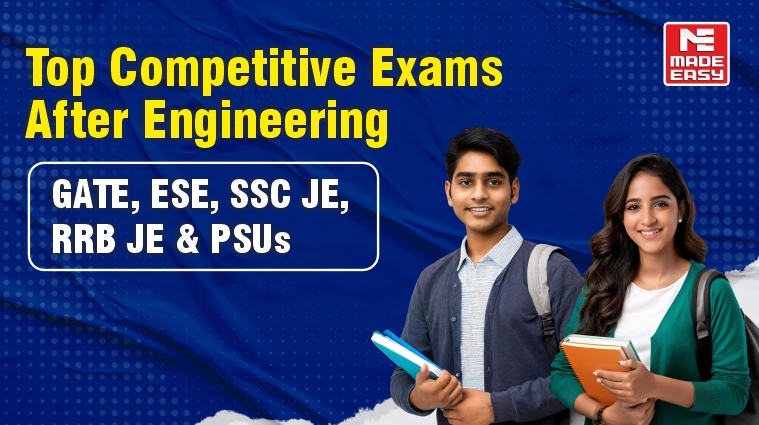
If you are also thinking about what are the top competitive exams after engineering, there are many options available based on the stream, career goals and eligibility criteria. Some of the most popular competitive exams include the GATE exam, ESE exam, SSC JE, RRB JE and other PSU examinations. These examination tests are about the technical knowledge you have already built during the degree so that the 4 years of hard work do not go to waste.
In this article, we will discuss some of the important competitive exams for engineering students and graduates, the eligibility criteria, exam pattern, career opportunities and how to select the right exam.
Why Must You Appear for Competitive Exams After Engineering
Basically, after the completion of a BTech/BEE degree, the candidates have multiple career options. They can either join the corporate sector, or they can prepare for higher studies, prepare for government jobs and target PSU jobs.
The engineering competitive exam would be the best option if you want:
- Government engineering jobs
- Secured a career in the public sector undertaking
- Admission to MTech and other PhD courses
- Opportunities in engineering services
Selection of the right exam depends on what you want to achieve. The GATE exam is suitable for the candidates who wish to secure admission to master’s and PhD courses and be part of the PSU recruitment process. The ESE exam offers opportunities under the government of India. SSC JE and RRB JE are viable options for the candidate who is looking for opportunities as a junior engineer in Indian railways. Let’s look at the top 5 competitive exams after engineering.
1. GATE Exam (Graduate Aptitude Test in Engineering)
The GATE exam is one of the most well-known and versatile exams among the engineering competitive exams in India. This exam is conducted by the IITs and IISc Bangalore on a rotational basis. For the next year, GATE 2027 will be conducted by IIT Madras. The GATE exam is helpful for securing admission to the master’s courses and PhD courses at top IIT, NIT, IIIT and IISc and recruitment to many PSUs of India.
GATE Exam Eligibility Criteria
If you wish to appear for the GATE 2027 exam, then you must follow the GATE eligibility criteria:
- The candidate must be in the final year of graduation or must have completed the engineering degree
- If the candidate is pursuing a BArch course, then the candidate must be in the 3rd year or higher.
- The candidates who are pursuing or have completed BSc degree, an MSc degree, an MA, an MCA or an integrated ME/MTech degree are also eligible for the GATE exam.
GATE Exam Age Limit
There is no upper age limit criteria for the GATE exam. Undergraduate students and graduates are both eligible for the GATE exam in 2027.
GATE Exam Pattern
The GATE exam is a computer-based test which is conducted for almost 30 papers. The candidates have the option to opt for the two-paper combination. This exam is an objective-based exam of 3 hours. The major topics included in the GATE exam are general aptitude, engineering mathematics and core technical subjects. The GATE exam consists of 65 questions of 100 marks. There are MCQ, MSQ and NAT-based questions. The GATE exam is valid for 3 years. There is negative marking applicable for the GATE exam. For every 1 marker wrong answer, ⅓ mark is deducted. For every 2 mark wrong answer, ⅔ marks are deducted.
2. Engineering Service Examination
ESE exams, which is popularly known as the Indian Engineering Services Examination. This examination is conducted by UPSC, and it is one of the most prestigious competitive exams after engineering. After clearing this exam, candidates get into group A and group B under the different ministries of government of India. The ESE exam is conducted in 3 stages, i.e., prelims, mains and interview.
ESE Exam Eligibility Criteria
To be eligible for the IES exam, the candidate must have passed and qualified for the bachelor’s degree in engineering from the recognised university. This exam covers four branches, i.e., civil engineering, mechanical engineering, electronics and telecommunication engineering.
ESE Age Limit
To be eligible for the ESE exam, the candidate must be more than or equal to 21 years of age and not more than 30 years of age. The age relaxation criteria is applicable for the reserved category candidates.
ESE Exam Pattern
The ESE exam has the following selection criteria:
- Prelims exam: The ESE prelims exam is an objective-based paper which consists of 2 papers, i.e., paper 1 and paper 2. Paper 1 focuses on general studies and engineering aptitude. Paper 2 focuses on the engineering discipline selected by the candidate. The ESE prelims exam total marks are 500 marks and the duration to complete both the exams is 5 hours (paper 1 lasts for 2 hours and paper 2 lasts for 3 hours)
- Mains exam: ESE Mains is a descriptive-based paper in the selected engineering discipline. The Mains exam consists of 2 descriptive papers in the selected discipline by the candidate. Each paper is of 300 marks and must be completed in 3 hours. So the total marks for both papers is 600 marks, which must be completed in 6 hours
- Interview exam: All the candidates who qualify for the mains examination are called by the UPSC for a personality test in which the overall personality of the candidate is assessed to determine whether they are suitable for the group A or group B government role or not.
3. SSC JE
SSC JE is one of the most popular choices among the engineering students who wanted to secure the government job. SSC offers the junior engineer position in various fields such as civil engineering, mechanical engineering, and electrical engineering across different central government departments.
SSC JE Educational Qualification
To be eligible for the SSC JE exam, the candidate must have qualified for a bachelor’s degree in engineering/technology or a diploma in engineering domains such as civil engineering, mechanical engineering and electrical engineering.
The diploma holders must have atleast 3 years of experience in civil engineering, mechanical engineering and electrical engineering.
SSC JE Age Limit
The candidate must be more than 18 years of age and not more than 30 years of age.
SSC JE Exam Pattern
The SSC JE exam consists of 2 computer-based papers. Paper 1 is an objective-based examination which consists of 100 questions of 200 marks to be completed in 2 hours. Paper 1 consists of questions from general awareness, general intelligence and reasoning and general engineering.
Paper 2 is an objective-based examination which consists of questions from the specific engineering branch. This paper consists of 100 questions of 300 marks to be completed in 2 hours.
4. RRB JE
The RRB JE exam is one of the most popular exams for the candidates who wanted to work as the Junior engineer in the Indian Railways. This opportunity provides technical position in different engineering disciplines and railways department.
RRB JE Eligibility Criteria
To be eligible for the RRB JE exam, the candidate must have qualified for a BTech/BTE degree from the recognised university or must have qualified for a three-year diploma in an engineering discipline.
The candidate must be an Indian citizen.
RRB JE Age Limit
The candidate must be more than 18 years of age and not more than 33 years of age. Age relaxation is applicable for the reserved category candidates.
RRB JE Exam Pattern
The RRB JE exam consists of 2 computer-based tests, i.e., CBT 1 and CBT 2, followed by document verification and a medical exam. The CBT1 is considered the screening test. It consists of 100 questions of 100 marks, to be completed in 90 minutes. This paper consists of questions from general awareness, general intelligence and reasoning ability and general science. For every wrong answer, negative marking will be applicable.
The candidates who qualify for the CBT 1 need to appear for the CBT 2. This paper consists of 150 questions of 150 marks, which must be completed in 120 minutes or 2 hours. This paper consists of questions from physics and chemistry, general awareness, the basics of computers and applications, basics of environment and pollution control and technical ability
5. PSU Recruitments 2027
Basically, apart from the GATE exam, ESE exam, SSC JE and RRB JE, PSU recruitment through the GATE is one of the most sought-after career options for the engineering students. PSUs such as ONGC, NTPC, BHEL, IOCL and other major PSUs recruit the engineering graduates with the help of different selection processes. There are many PSUs which use the GATE scores, while there are some which conduct separate entrance examinations.
PSU Exam Eligibility Criteria
PSU exam eligibility criteria vary from company to company and post selected by the candidates. The basic eligibility criteria are that the candidate must have the valid GATE score in the engineering branch and must hold the graduation degree from the recognised university. There are some PSUs which set the minimum marks or GATE score requirements.
PSU Exam Age Limit
The PSU exam age limit varies from company to company. The maximum age limit depends on the post selected by the candidate. Age relaxation is applicable for the reserved candidates.
Frequently Asked Questions
Q1. Which is the best competitive exam after engineering?
Ans: The best competitive exam after engineering depends on the career goals of the candidates. There are many competitive exams after engineering, such as GATE, SSC JE, RRB JE and ESE services examinations. Each exam provides different career opportunities and growth in different sectors.
Q2. Can a BTech graduate apply for SSC JE?
Ans: Yes, BTech graduates who have completed their graduation in civil, electrical or mechanical engineering can apply for the SSC JE exam.
Q3. Is RRB JE suitable for engineering graduates?
Ans: Yes, RRB JE is considered to be suitable for engineering graduates in India. This exam is suitable for the candidates who want to take up roles such as technical junior engineer in the Indian railways.
Q4. Which exam is easier after engineering?
Ans: There is no examination which is easier after engineering. Each exam requires hard work and dedication. The difficulty level depends on the engineering branch selected by the candidates, preparation level, syllabus and strengths. SSC JE and RRB JE can be considered as the most suitable exams for the candidates who are targeting junior-level recruitments.
Q5. Can final-year B.Tech students appear for GATE and ESE?
Ans: Yes, the final year BTech students are eligible for the GATE and ESE exams. The final candidates can only appear for the ESE prelims exams. While final-year candidates can appear for the GATE exam.
Dear Aspirants, Your preparation for GATE, ESE, PSUs, and AE/JE is now smarter than ever — thanks to the MADE EASY YouTube channel. This is not just a channel, but a complete strategy for success, where you get toppers strategies, PYQ–GTQ discussions, current affairs updates, and important job-related information, all delivered by the country’s best teachers and industry experts. If you also want to stay one step ahead in the race to success, subscribe to MADE EASY on YouTube and stay connected with us on social media. MADE EASY — where preparation happens with confidence.