Every year, many candidates appear for the UPSC ESE exam, but fewer than 500 are able to crack the exam. The gap is not about intelligence; it is about who planned early and who started late.
Cracking UPSC ESE 2027-28 in the first attempt needs more than just completing the syllabus. A well-planned strategy can help the candidate manage the extensive UPSC ESE syllabus, strengthening technical concepts and improving performance in both prelims and mains. As this exam has three stages, candidates need to start preparation early and maintain consistency throughout the journey.
In this article, we will provide important insights and ideas on how to crack UPSC ESE in the first attempt for both the prelims and mains exams.
How to Crack UPSC ESE in the First Attempt?
The dream of passing ESE in the 1st attempt is the ultimate goal of many students, as the UPSC ESE prelims are all set to be conducted on 31 January 2027. While the competition will be high, candidates must have a strong and efficient preparation approach in order to ace the test and stand out from the crowd.
As the ESE syllabus is very wide and huge, preparing for UPSC ESE 2027 or 2028 might be intimidating. But sticking to the study programme and an efficient UPSC IES preparation strategy might be a game changer in terms of overall engineering service examination preparation.
UPSC ESE Eligibility Criteria and Age Limit
- The candidate must be a citizen of India or a subject of Nepal or Bhutan or a Tibetan refugee who came to India before 1st January 1962 or a person of Indian origin who has migrated from a specified country with the intention to settle permanently in India.
- Candidates must have completed a bachelor’s degree in technology or engineering or an equivalent in civil, electrical, mechanical or electronics and telecommunication engineering from a recognised university. Candidates who have completed a master’s degree in a specific discipline are eligible to apply for the UPSC ESE exam.
- The final-year candidates can apply for the UPSC ESE exam, but they must submit the proof of qualification before the deadline stated by the commission.
- The candidate’s age must be between 21 and 30 years old.
- There is no limit on the number of attempts. Students can appear as often as they like until they cross the age limit.
UPSC ESE Exam pattern 2027-2028
.The UPSC ESE prelims exam consists of 2 objective papers, i.e., General Studies and Engineering Aptitude and engineering domain-specific papers. The prelims exam tests technical knowledge along with general awareness, engineering aptitude, reasoning, mathematics and related areas
The candidates who qualify the ESE prelims exam need to appear for the UPSC ESE Mains 2027. This paper is descriptive, based on the discipline selected by the candidates. The main stage needs conceptual clarity and answer-writing practice. Learning only formulas is not enough to crack the UPSC ESE Mains 2027.
The candidates who qualify for the Mains examination are called for the interview or personality test. The interview is of 200 marks. The board will assess the technical knowledge and awareness about the infrastructure and policy issues. The final merit list is prepared on the basis of marks in mains and interview.
|
Stage |
Subject | Duration | Maximum marks |
|---|---|---|---|
| Prelims | General Studies and Engineering Aptitude + engineering-specific discipline | 2 hours + 3 hours |
500 |
|
Mains |
Paper 1 and Paper 2: engineering discipline specific | 3 hours + 3 hours | 600 |
| Interview |
200 |
How to crack UPSC ESE in the first attempt: Prelims and Mains strategy
- Understanding the exam pattern: The candidate must know about the sectional topics, number of questions and marking scheme. This will help in removing exam-day anxiety. For the candidates, nothing will be new except the questions.
- Strong fundamentals: Start building fundamentals from the standard textbooks. Instead of chasing the difficult questions, first understand the basic questions. Focus on understanding the important formulas, theories, common assumptions and conditions. Once the fundamentals are clear, you can look for the previous year’s question papers and advanced-level problems.
- Create the study plan: The UPSC ESE study plan must be based on the time available, academic background and the examination. You can divide the syllabus into smaller sections rather than completing the entire subject in one day. Allocate more time for difficult subjects while maintaining revisions.
- Right Study resources: For the ESE exam, using too many books and resources can create confusion. The candidate must select only one reliable source for learning concepts and solve the ESE previous year question papers and test series. The main objective must be to stick to one reliable resource and revise the same multiple times instead of studying from many sources.
- Solve numerical problems: Practising numerical questions is very important for the engineering disciplines. After completing every topic, focus on solving numerical problems, concept-based questions, previous year question papers, and full-length descriptive questions.
Realistic Study Plan For 2027-28
If you are also someone who is targeting UPSC 2027-28, you can divide your preparation in the following way:
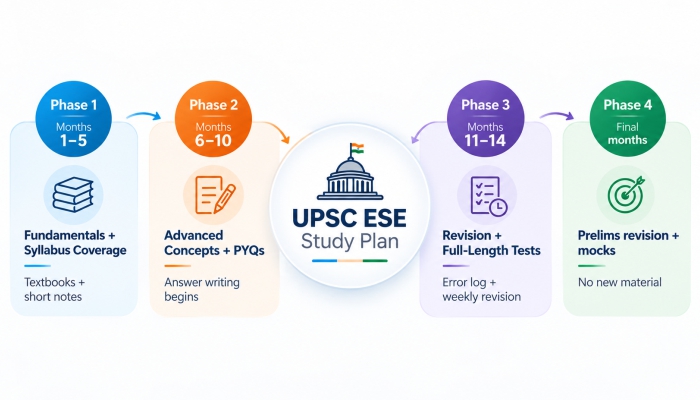
Final Words
Qualifying for the UPSC ESE exam in the first attempt does not require any unrealistic timetable or studying continuously for long hours, but the candidate must have clear direction, and they must follow the plan consistently. First, have a basic understanding of the UPSC ESE syllabus and exam pattern, have strong technical knowledge, solve PYQs and revise regularly. Do not measure preparation by the number of hours studied; instead, measure it by the number of topics completed, questions solved and revisions completed.
With the help of the well-structured UPSC preparation strategy and consistent practice, students targeting ESE 2028 or 2029 can build their preparation systematically and give the examination with confidence.
Frequently Asked Questions
Q1: How to make a UPSC study timetable for beginners?
Ans: If you are also a beginner who has started for UPSC ESE, you must create a realistic timetable based on your available study hours. You can divide the day between concept building, revision and solving PYQs. Start with the smaller targets and gradually increase the study duration. Once a week, dedicate a few hours for revisions and test analysis.
Q2: How to use UPSC previous year questions for preparation?
Ans: UPSC ESE previous year question papers must be used alongside the main preparation, not only before the examination. As soon as you complete any topic, start solving the PYQs to have an understanding about the question pattern, identify important concepts and assess your preparation. You must maintain a record of the incorrect questions and revise them on a regular basis.
Q3: What is the best daily routine for UPSC preparation?
Ans: A good routine must include 6-8 hours of focused study; divide the slots into learning new topics, solving questions and revisions. Avoid continuous study sessions for longer durations. You must include short breaks, revision sessions and adequate sleep in your routine.
Q4: What should I do before starting UPSC preparation?
Ans: Before starting for the UPSC ESE exam, have a proper understanding of the UPSC ESE syllabus, exam pattern, eligibility criteria and PYQs. Then decide on the target examination, know your strengths and weaknesses, choose reliable resources, prepare a timetable and have proper planning before starting the preparation to avoid any kind of confusion.
Q5: How can I complete the UPSC syllabus on time?
Ans: You can divide the syllabus into smaller parts and then set weekly targets. Track the progress regularly. You must prioritise important topics and avoid using too many resources. Do include revision sessions while completing any topics. Keep the final days for revision, PYQs, and mock tests rather than starting any new topic.
Dear Aspirants, Your preparation for GATE, ESE, PSUs, and AE/JE is now smarter than ever — thanks to the MADE EASY YouTube channel. This is not just a channel, but a complete strategy for success, where you get toppers strategies, PYQ–GTQ discussions, current affairs updates, and important job-related information, all delivered by the country’s best teachers and industry experts. If you also want to stay one step ahead in the race to success, subscribe to MADE EASY on YouTube and stay connected with us on social media. MADE EASY — where preparation happens with confidence.