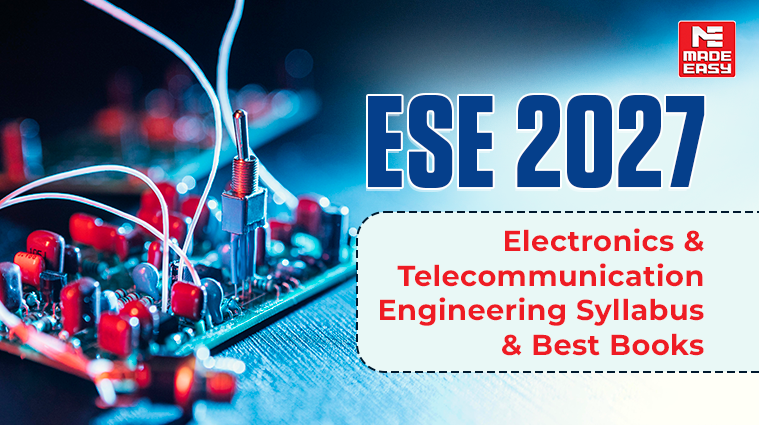
Electronics and telecommunication engineering is considered one of the top-rated engineering streams, which forms part of the engineering services examination. So, if you are also preparing for the UPSC ESE examination 2027, then you must have an understanding about the electronics and telecommunication engineering syllabus; it is the foundation of the successful preparation strategy. The UPSC ESE syllabus has a broad range of technical subjects which will assess conceptual knowledge, analytical skills and engineering problem-solving skills.
So, if you are looking for the ESE electronics and telecommunication engineering syllabus, what is electronics and telecommunication engineering? And about the best books for UPSC ESE of electronics and telecommunication, in this article we will discuss everything about electronics and telecommunication engineering.
What is Electronics and Telecommunication Engineering?
Electronics and Telecommunication Engineering is one of the top engineering streams that forms part of the Engineering Services Examination (ESE). This is one of the most challenging exams for engineering students in the government sector, especially for engineering graduates and students belonging to the electronics and telecommunication engineering background. The selected candidates receive selection at some of the top government organisations in the railways, naval, telecom, and power engineering sectors for the Grade A and B posts.
Electronics and Telecommunication Engineering Exam Pattern 2027
| Particulars | Details |
| Mode of examination | Offline |
| Stage 1: Preliminary Examination | |
| Paper 1: general studies and engineering aptitude paper | |
| Total marks | 200 marks |
| Duration of exams | 2 hours |
| Paper 2: Engineering Discipline, Specific Paper | |
| Total Marks | 300 |
| Examination Duration | 3 |
| Stage 2: mains examination | |
| Paper 1: Engineering Discipline, specific paper-1 | |
| Total marks | 300 marks |
| Duration of examination | 3 hours |
| Paper 2: Engineering Discipline, specific paper 2 | |
| Total marks | 300 |
| Duration of the examination | 3 hours |
Electronics and Telecommunication Engineering Syllabus
The standard of the paper in General Studies and Engineering Aptitude (Preliminary Stage I Examination) will be as may be expected of an engineering or science graduate. The standard of papers in other subjects will approximately be that of an engineering degree examination at an Indian university. There will be no practical examination in any of the subjects. One must keep the following points in mind concerning General Studies and Engineering Aptitude (Preliminary Examination/Stage I, Paper I, Objective Type, Common to All Candidates):
| Subjects | Syllabus |
| General studies and engineering aptitude | Basics of material science and engineering Engineering aptitude Standards and quality practices in production, construction, maintenance, services, and project management basis Ethics and values in engineering profession Current affairs Engineering mathematics and numerical analysis General principles of design, drawings and the Importance of safety Information and communication technology Basics of energy and environment |
The paper in General Studies and Engineering Aptitude will include knowledge of relevant topics, as may be expected from an engineering graduate, without special study. Questions from all the 10 topics mentioned above shall be set. The marks for each of the topics in both papers range from 5% to 15% of the total marks in the paper.
The contents of the syllabus for both papers are together for the preliminary examination (Stage I) and separately for the mains (Stage II) examination. The preliminary examination associated with the ESE 2026 syllabus comprises mainly the objective type Paper-II. The next part of the ESE 2026, i.e., the Mains Examination, comprises the conventional types, Paper I and Paper II.
Electronics and Telecommunication Engineering Syllabus – paper 1
| Subjects | Topics |
| Basics electronic engineering | Basic of semiconductors, diode/transistor basics and characteristics, diodes for different uses, junction and field-effect transistors, transistors amplifiers of different types, oscillators and other circuits, basics of integrated circuits (bipolar, MOS, CMOS, ICs), basics of linear ICs, operational amplifiers and their applications, optical sources or detectors, the basics of optoelectronics and their applications |
| Basic electrical engineering | DC circuits: Ohm’s and Kirchhoff’s laws, mesh and nodal analysis, circuit theorems; Electromagnetism, Faraday’s and Lenz’s laws induced EMF and its uses; Single-phase AC circuits; Transformers, efficiency; Basics: DC machines, induction machines, and synchronous machines; Electrical power sources: Basics: hydroelectric, thermal, nuclear, wind, and solar; The basics of batteries and their uses. |
| Material science | Electrical engineering materials; crystal structure and defects; Ceramic materials—structures, composites, processing and uses; Insulating laminates for electronics, structures, properties and uses Magnetic materials, basics, classification, ferrites, ferro/paramagnetic materials and components Nanomaterials: basics, preparation, purification, sintering, nanoparticles and uses; Nano Optical, magnetic or electronic materials and uses superconductivity. |
| Electronics measurement and instrumentation | Principles of measurement, accuracy, precision and standards; Analog and digital systems for measurement; measuring instruments for different applications; Static and dynamic characteristics of measurement systems, errors, statistical analysis and curve fitting, Measurement systems for non-electrical quantities; The basics of telemetry Different types of transducers and displays; Data acquisition system basics. |
| Network theory | Network graphs and matrices; Wye-Delta transformation; linear constant coefficient differential equations: time domain analysis of RLC circuits; solution of network equations using Laplace transforms frequency domain analysis of RLC circuits; 2-port network parameters, driving point and transfer functions; state equations for networks; steady-state sinusoidal analysis. |
| Analog and digital circuits | Small signal equivalent circuits of diodes, BJTS and FETs; Diode circuits for different uses; Biasing and stability of BJT and JFET amplifier circuits; Analysis and design of amplifiers, single or multi-stage; Feedback and uses: Active filters, timers, multipliers, wave shaping, A/D-D/A converters, Boolean algebra, and uses; logic gates; digital IC families; combinatorial and sequential circuits; The basics of multiplexers, counters, registers, memories, microprocessors, design, and applications. |
Electronics and Telecommunication Engineering Syllabus – Paper 2
| Subjects | Topics |
| Analog and digital communication systems | Random signals, noise, probability theory, and information theory; Analog versus digital communication and applications: systems (AM, FM, transmitters and receivers), theory, practice and standards; SNR comparison; Digital communication basics: sampling, quantizing, coding, PCM, DPCM, multiplexing audio/video. Digital modulation: ASK, FSK, PSK; Multiple access: TDMA, FDMA, CDMA; Optical communication: fibre optics, theory, practice and standards. |
| Control system | Classification of signals and systems; Application of signal and system theory; System realisation: transforms and their applications; Signal flow graphs, Routh-Hurwitz criteria, root loci, Nyquist/Bode plots; feedback systems: open- and closed-loop types, stability analysis, steady state, transient and frequency response analysis; design of control systems, compensators, elements of lead/lag compensation, PID and industrial controllers. |
| Computer organizations and architecture | Basic architecture, CPU, I/O organization, memory organization, peripheral devices, trends; Hardware and software issues Data representation and programming; Operating systems-basics, processes, characteristics, applications; Memory management, virtual memory, file systems, protection and security; Databases, different types, characteristics and designs; Transactions and concurrency control; Elements of programming languages are typical examples |
| Electromagnetics | Elements of vector calculus, Maxwell’s equations—basic concepts; Gauss’ and Stokes’ theorems; Wave propagation through different media; Transmission lines—different types, basics, Smith’s chart, impedance matching and transformation, S-parameters, pulse excitation, uses; Waveguides—basics, rectangular types, modes, cut-off frequency, dispersion, dielectric types; Antennas—radiation pattern, monopoles/dipoles, gain, arrays—active/passive, theory, uses |
| Advanced electronic types | VLSI technology: processing, lithography, interconnects, packaging and testing; VLSI design: principles, MUX, ROM or PLA-based design, Moore & Mealy circuit design, pipeline concepts and functions, and design for testability examples; DSP: discrete time signals and system uses. Digital filters: FIR/IIR types, design, speech, audio, and radar signal processing uses; microprocessors & microcontrollers, basics, interrupts, DMA, instruction sets, and interfacing; controllers and uses; and embedded systems. |
| Advanced communication topics | Communication networks: principles, practices, technologies, uses, OSI model and security; Basic packet multiplexing streams and scheduling; Cellular networks, types, analysis, protocols (TCP/TCP IP); Microwave and satellite communication: terrestrial and space-type LOS systems, block schematics, link calculations, and system design; communication satellites, orbits, characteristics, systems, and uses; Fiber-optic communication systems, block schematics, link calculations, and system design. |
Therefore, these are the details associated with the UPSC ESE 2026 syllabus. If you want to excel in your upcoming ESE exam attempt, then you must prioritise using the available resources for result-orientated ESE Exam 2026 preparation.
This completes the detailed ESE Electronics and Telecommunication Engineering exam syllabus that will help candidates prepare for this course in the best possible way. After understanding the syllabus, let’s find out the most useful resources, including MADE EASY ESE 2026 Electronics and Telecommunication Engineering Books.
Best Books for UPSC ESE of Electronics and Telecommunication
| S. No. | Subject | Book Name |
| 1 | Electric Circuits | Network Analysis, Fundamentals of Electric Circuits |
| 2 | Control Systems | Control Systems Engineering |
| 3 | Signals and Systems | Signals and Systems, Digital Signal Processing |
| 4 | Power Systems | MADE EASY Theory Books: Power Systems Power System Engineering Power System Analysis |
| 5 | Analog Electronics | Microelectronic circuits Electronic Circuits: Analysis and Design |
| 6 | Digital Electronics | Digital Design Digital Fundamentals |
| 7 | Microprocessors | Fundamentals of Microprocessors and Microcontrollers |
| 8 | Communication Systems | Communication Systems (Fourth Edition) Modern Digital and Analog Communication Systems |
| 9 | Electromagnetic Fields | Principles of Electromagnetics |
| 10 | Electrical Materials | Materials Science and Engineering Electrical Engineering Materials Introduction to Nanotechnology |
| 11 | Electrical and Electronic Measurements | A Course in Electrical and Electronic Measurements and Instrumentation Electrical Measurements and Measuring Instruments |
| 12 | Electrical Machines | Electrical Machinery Electric Machines |
| 13 | Power Electronics | Power Electronics Power Electronics Circuits, Devices, and Applications |
| 14 | Engineering Mathematics | Advanced Engineering Mathematics |
| 15 | Computer Fundamentals | Computer System Architecture Operating System Concepts |
If you are looking for the best Electronics and Telecommunication Engineering books, then check out the following MADE EASY Prelims books that have helped several electronics and telecommunication engineering aspirants:
ESE 2027: Preliminary Exam: Electronics and Telecom. Engineering Objective Solved Paper Vol-1 ESE 2027: Preliminary Exam: Electronics and Telecom. Engineering Objective Solved Paper Vol-2
If your friends are from other engineering streams and want to appear for the Engineering Services Examination (ESE), then feel free to recommend the following blog posts with useful information regarding the other engineering streams:
ESE 2026 Civil Engineering Syllabus and Books
ESE 2026 Mechanical Syllabus and Books
ESE 2026 Electrical Syllabus and Books
Therefore, this completes the detailed information associated with the ESE Examination Syllabus for Electronics and Telecommunication Engineering
UPSC ESE Preparation Strategy
Set a realistic schedule: To reach your goals, start by creating a time schedule and sticking to it. However, making a realistic and practical schedule is very important. Everyone has a better understanding of their study schedule. It is advisable to set a realistic time that you can follow. A realistic schedule will motivate you to study, and it’s important to include breaks in your timetable. Coming back with a fresh mind will not only help you tackle difficult topics but also help you achieve success in your exams.
Divide and conquer: follow the strategy of dividing the larger topics further into subtopics. In that way, it will help you complete the topics easily and on time. Begin with topics you find easy to understand to boost your motivation. This strategy is very helpful with difficult topics, as they are time-consuming, so you have the required time to complete certain difficult topics.
Don’t Get Stuck for Too Long: When a topic is difficult, students tend to give it more time but don’t realise the time constraint. Instead of getting stuck, take breaks to revise what you’ve already learned or move on to new topics. Returning to difficult subjects with a fresh mind after a break can help you understand them better.
Try mock tests and past-year questions: Attempting the mock test and previous-year questions of ESE Electronics and Telecommunications will give you a brief idea of the real experience of the exam and the time constraint. Instead of getting stuck, take breaks to revise what you’ve already learned or move on to new topics. Returning to difficult subjects with a fresh mind after a break can help you understand them better.
Stick to your plan: Everyone is aware of their study pattern and environment. So make a realistic plan, as you know the best possible way to achieve your goals. Everyone will give their tips, advice, and suggestions regarding the preparation. Although listening to them is good, following and sticking to your plan is essential. Minimise distractions, and if you feel your plan isn’t working well, make small changes within a four-week timeframe to see progress.
Frequently Asked Questions
Basically, if you wish to start preparing for the ESE 2027 E & T, start by having a thorough understanding about the ESE Electronic and Telecommunication syllabus and exam pattern. You must try to complete the technical subjects with the help of the standard textbooks. Do make short notes and formula sheets, which can be used for revision purposes. Daily attempt the mock tests and improve speed and accuracy. Revise consistently instead of last-minute revision.
Dear Aspirants, Your preparation for GATE, ESE, PSUs, and AE/JE is now smarter than ever — thanks to the MADE EASY YouTube channel. This is not just a channel, but a complete strategy for success, where you get toppers strategies, PYQ–GTQ discussions, current affairs updates, and important job-related information, all delivered by the country’s best teachers and industry experts. If you also want to stay one step ahead in the race to success, subscribe to MADE EASY on YouTube and stay connected with us on social media. MADE EASY — where preparation happens with confidence.
Yes, the ESE 2027 E AND T syllabus is significantly different from the GATE examination. The ESE examination is considered to broader than the GATE syllabus. Some of the key differences under the ESE E&T syllabus and GATE syllabus include:
ESE has general aptitude and engineering aptitude, while on the other hand GATE does not have any kind of technical syllabus.
ESE has 3 levels i.e. prelims, mains and interview. The GATE examination is a completely objective based papet.
ESE provides great emphasis on the engineering applications and written problem-solving skills.
Dear Aspirants, Your preparation for GATE, ESE, PSUs, and AE/JE is now smarter than ever — thanks to the MADE EASY YouTube channel. This is not just a channel, but a complete strategy for success, where you get toppers strategies, PYQ–GTQ discussions, current affairs updates, and important job-related information, all delivered by the country’s best teachers and industry experts. If you also want to stay one step ahead in the race to success, subscribe to MADE EASY on YouTube and stay connected with us on social media. MADE EASY — where preparation happens with confidence.
Yes, the ESE E&T syllabus is the same every year. It remains largely unchanged from year to year. The UPSC makes minor changes or clarifications on the topics through the official notifications, but major subjects remain the same.
Dear Aspirants, Your preparation for GATE, ESE, PSUs, and AE/JE is now smarter than ever — thanks to the MADE EASY YouTube channel. This is not just a channel, but a complete strategy for success, where you get toppers strategies, PYQ–GTQ discussions, current affairs updates, and important job-related information, all delivered by the country’s best teachers and industry experts. If you also want to stay one step ahead in the race to success, subscribe to MADE EASY on YouTube and stay connected with us on social media. MADE EASY — where preparation happens with confidence.
After qualifying the ESE E&T examination, candidates are appointed as Grade A or Grade B legal officers in various central government departments and organisations.
Dear Aspirants, Your preparation for GATE, ESE, PSUs, and AE/JE is now smarter than ever — thanks to the MADE EASY YouTube channel. This is not just a channel, but a complete strategy for success, where you get toppers strategies, PYQ–GTQ discussions, current affairs updates, and important job-related information, all delivered by the country’s best teachers and industry experts. If you also want to stay one step ahead in the race to success, subscribe to MADE EASY on YouTube and stay connected with us on social media. MADE EASY — where preparation happens with confidence.
There is no flexed definition of a good score in the ESE E&T preliminary examination. The good score depends on various factors such as difficulty level of the examination, vacancies and candidates’ performance. But if an individual scores more than 250 marks, then it can be considered a safe score for qualifying for the ESE E&T preliminary examination.
Dear Aspirants, Your preparation for GATE, ESE, PSUs, and AE/JE is now smarter than ever — thanks to the MADE EASY YouTube channel. This is not just a channel, but a complete strategy for success, where you get toppers strategies, PYQ–GTQ discussions, current affairs updates, and important job-related information, all delivered by the country’s best teachers and industry experts. If you also want to stay one step ahead in the race to success, subscribe to MADE EASY on YouTube and stay connected with us on social media. MADE EASY — where preparation happens with confidence.
Some of the best books for the ESE 2027 E&T preparation are as follows: –
| Subjects | Recommended books and authors |
| Basic electronics | Microelectronic Circuits – Sedra and smith |
| Electric Circuits | Network Analysis – M. E. Van Valkenburg Fundamentals of Electric Circuits – Charles K. Alexander Matthew N. O. Sadiku |
| Control Systems | Control Systems Engineering – Norman Nise Control Systems Engineering – I. J. Nagrath, M. Gopal |
| Signals and Systems | Signals and Systems – Alan V. Oppenheim, Alan S. Willsky Digital Signal Processing – John G. Proakis Dimitris G. Manolakis |
| Analog Electronics | Microelectronic Circuits – Adel S. Sedra, Kenneth C. Smith Electronic Circuits: Analysis and Design Donald A. Neamen |
Dear Aspirants, Your preparation for GATE, ESE, PSUs, and AE/JE is now smarter than ever — thanks to the MADE EASY YouTube channel. This is not just a channel, but a complete strategy for success, where you get toppers strategies, PYQ–GTQ discussions, current affairs updates, and important job-related information, all delivered by the country’s best teachers and industry experts. If you also want to stay one step ahead in the race to success, subscribe to MADE EASY on YouTube and stay connected with us on social media. MADE EASY — where preparation happens with confidence.
Dear Aspirants, Your preparation for GATE, ESE, PSUs, and AE/JE is now smarter than ever — thanks to the MADE EASY YouTube channel. This is not just a channel, but a complete strategy for success, where you get toppers strategies, PYQ–GTQ discussions, current affairs updates, and important job-related information, all delivered by the country’s best teachers and industry experts. If you also want to stay one step ahead in the race to success, subscribe to MADE EASY on YouTube and stay connected with us on social media. MADE EASY — where preparation happens with confidence.